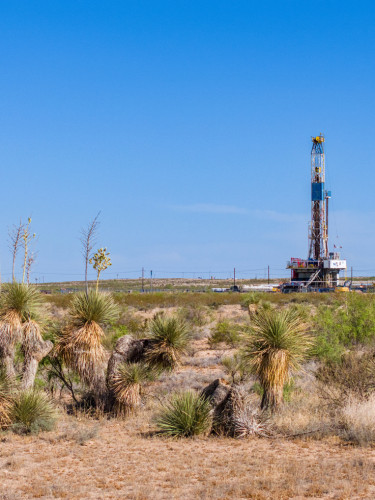
 The Surmont heavy oil sands project, located southeast of Fort McMurray Alberta, Canada. |
Northern Alberta is home to the oil sands, one of the world’s largest known oil deposits. This resource is considered second in size only to those found in Saudi Arabia, but comes with its share of challenges given the way the oil is trapped in the sand.
The oil sands contain a ‘heavy’ form of crude oil that requires special extraction methods to get it out of ground and into a form where it is fluid enough to travel down pipelines for refining into gasoline and other hydrocarbon products.
There are currently two common commercial methods for producing this heavy oil – mining and in-situ (Latin for “in place”) production. While approximately 18 percent of the total oil sands’ recoverable reserves are close enough to the surface (within 250 feet) to be recovered through surface mining, the vast majority of oil sands deposits average depths of 1,300 feet below the surface and can only be recovered using in-situ recovery techniques, such as Steam-Assisted Gravity Drainage (SAGD).
ConocoPhillips in the Oil Sands
ConocoPhillips is well positioned to become a leading in-situ producer in the Athabasca oil sands region, with more than a million net acres of leaseholdings. Over the next two or three decades, our production from this resource could reach as high as 1 million barrels of oil per day. More than 99 percent of our leaseholdings are in areas that will be developed using in-situ techniques such as SAGD, and we also hold a minor interest in a mining company, Syncrude. ConocoPhillips holds the following oil sands assets:
- Surmont Project. The Surmont Project is a multi-phase SAGD project. This 50/50 joint venture with Total E&P Canada is operated by ConocoPhillips and is currently in its first phase of development. Phases one and two of Surmont are projected to produce 110,000 barrels per day (BPD) when they reach peak commercial production. Significant potential exists for further expansion.
- FCCL Partnership. The FCCL Partnership is a 50/50 partnership between ConocoPhillips and EnCana Corporation, consisting of the Foster Creek and Christina Lake SAGD projects. EnCana operates these two projects on behalf of the partnership with the goal of increasing production to 400,000 BPD.
- Other In-Situ Leaseholdings. ConocoPhillips has other significant leaseholdings in the Athabasca region, located in the Thornbury, Clyden and Saleski areas. These properties will be developed using in-situ technology and ConocoPhillips has 100 percent working interest in them.
- Syncrude. ConocoPhillips owns a 9 percent interest in Syncrude, a mining project that also has extraction and upgrading facilities that convert the mined bitumen to synthetic crude oil.
Steam-Assisted Gravity Drainage
SAGD is used to recover the heavy oil that is buried deep beneath the surface. A pair of horizontal wells is drilled from a central well pad. In a plant nearby, steam generators transform water into steam which then travels through above-ground pipelines to the wells. It enters the ground via the steam injection (top) well. The steam heats the oil until it reaches a temperature where it can flow to the producing (bottom) well. The steam injection and oil production happen continuously and simultaneously. The resulting oil and condensed steam emulsion is then piped from the producing well to the plant, where it is separated and treated. The water is recycled for generating new steam and ConocoPhillips’ heavy oil is blended with synthetic crude oil and shipped by pipeline to the United States for refining.

Opportunities and Challenges
The oil sands represent an important energy resource for North America as well as a future growth opportunity for ConocoPhillips, but reaching their full potential will not be without challenges. Specifically, our stakeholders are concerned about our industry meeting the environmental and social challenges associated with oil sands development. As the industry grows, so do the concerns about the cumulative impacts of developing the oil sands on the air, water, land and local communities. ConocoPhillips is working with industry, local communities and government to address these issues, including our technology investment of between $300 and $500 million over the next five years to advance heavy oil technology, which includes research on managing oil sands environmental issues.
Managing Greenhouse Gases
On a lifecycle basis, from when the oil is produced from the well to its end use as fuel by the consumer, greenhouse gas emissions from oil sands are about 6 percent to 15 percent higher than the average crude oil consumed in the United States. However, the production phase (from the well to the plant gate) emits three or four times more greenhouse gas-intensive than conventional oil extraction due to the energy intensive nature of producing the steam. In SAGD production, we currently use natural gas as a fuel source, the combustion of which produces carbon dioxide and small amounts of methane. We are assessing and researching technology to reduce and manage these greenhouse gas emissions. Finding ways to reduce the steam-oil ratio – the amount of steam it takes to produce a barrel of oil from the oil sands – is one way to reduce our intensity. We’re participating in industry groups to further research the implementation of carbon capture and storage for the oil sands as another means to reducing our impact. ConocoPhillips is also assessing alternative fuel sources for SAGD and new steam generation technologies that may help us significantly reduce future greenhouse gas emissions from oil sands production.
Reducing Water Use
There is concern about the cumulative consumption of freshwater resources by the oil sands industry. Non-potable water from deep underground aquifers is used to create steam for the SAGD process. The steam is injected into the wells, where it heats the oil, and is recovered from the well with the oil as it is brought to surface. The water is then separated from the oil and recycled. We are targeting a 90+ per cent water recycle rate, as required by the regulatory agency, and are developing practices to conserve and protect freshwater resources, as well as enhance the efficiency of water use in our facilities. Reducing the steam-oil ratio is one way to use less water. We are also characterizing the watershed and are actively exploring for deep, non-potable saline water sources.
Minimizing Land Disturbances
Oil sands development contributes to cumulative land impacts through the multiple demands put on the region by the number of projects. These impacts affect biodiversity and wildlife habitats. We believe one of the best ways to address cumulative impacts is to manage land issues in a coordinated way, working with industry, communities, academics, scientists and governments. We are participating in an initiative led by the Alberta government to develop a land-use framework for the industry as a whole as well as using practices that minimize the impact of our own projects. While much less land is impacted in SAGD production than in mining, we disturb land when we clear areas for seismic lines, build roads and pipelines and construct processing facilities. We’re working to reduce our land disturbances in several ways. For example, we were an early adopter of low impact seismic line cutting technology. This technology reduces cut lines to about one third of their traditional width, minimizing land disturbance and keeping the forest canopy intact. Additionally, we coordinate all of our plans for roads and well pads with Alberta-Pacific Forest Industries’ plan for timber harvesting to minimize land disturbance by using common roads. At our Surmont project, we found ways to reduce by about half the footprint of our exploration well sites and the amount of linear infrastructure like roads and pipelines.
Enhancing Local Communities
The oil sands industry’s growth has brought benefits provincially and nationally through taxes, and to the region in the way of economic opportunity. It has also put strain on local communities and infrastructure. The influx of people and expendable income in the region can bring associated social concerns, such as increased housing prices and drug and alcohol abuse. There is also concern about the further impacts on traditional Aboriginal culture and ways of life. We are working to enhance local communities by creating and supporting social and community programs as well as creating local benefits and employment opportunities from oil sands development. In 2008, we sponsored more than 25 programs and events targeted to local youth. These programs focused on life-skills training and self-esteem initiatives and reached approximately 100 young community members. In addition to listening, a core focus of our stakeholder engagement is working to help these communities participate in the economic potential of the oil sands. Our stakeholder engagement coordinators work with Aboriginal communities to help them understand the opportunities available to them at Surmont. We have been successful in creating local opportunity. For example, in the development and construction of Surmont’s first phase, more than $60 million was spent on services provided by local and Aboriginal businesses and contractors.
Creating Cross-Border Benefits
The global energy industry is challenged, and will continue to be challenged, in finding enough supply to meet the ever-growing demand, especially as other parts of the world, like India and China, increase their energy consumption. The oil sands represent a politically stable, secure and enormous resource that can help North America meet energy demand for decades to come.
In addition to providing energy security for North Americans, the oil sands generate economic benefits on both sides of the border. In Canada, they contribute billions of dollars every year in taxes and royalties and provide nationwide employment and contracting opportunities. A 2005 study conducted by the Canadian Energy Research Institute forecasting economic impacts between 2000 and 2020 suggests investment of approximately $100 billion, a GDP increase of $885 billion, 6.6 million person years’ employment and $123 billion of government revenues due to oil sands development. The U.S. also realizes economic benefits from the oil sands in terms of the refinery upgrades and expansions that are planned or under way. The American Petroleum Institute estimates these projects will create more than 10,000 new construction jobs and an additional 500 permanent full-time refinery positions.