Water

Water plays a vital role in energy development. Water management priorities vary across our global operations and are influenced by resource characteristics and regional contexts. These differences reflect a range of factors, including local water availability and water stress, regulatory requirements, water use intensity, infrastructure capacity, economic and environmental conditions, and the presence or absence of nearby communities. Together, these considerations inform how water is sourced, treated, reused, discharged or disposed across our assets.
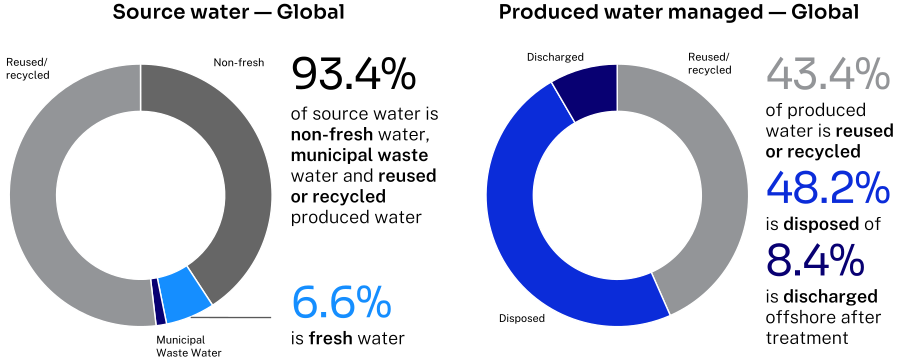
Our water sources include fresh, non-fresh, reused municipal waste water and reused/recycled produced water. These sources support a wide range of activities, including drilling, enhanced oil recovery (EOR), hydraulic fracturing, steam generation for steam-assisted gravity drainage (SAGD) oil sands production, natural gas and oil terminals, LNG production and domestic use.
Produced water from our onshore operations is treated and recycled to hydraulically fracture wells and generate SAGD steam, reused untreated for EOR, or disposed by well injection. Produced water from offshore operations is treated prior to discharge from offshore platforms in accordance with applicable local regulations. In addition, we manage waste water at LNG terminals and domestic waste water generated at remote staff accommodations. The examples in the table highlight mitigation measures implemented at selected operated assets over recent years, reflecting site‑specific operational practices shaped by local conditions.
| Fresh water use |
|
| Water infrastructure and transport |
|
| Research and monitoring |
|
ConocoPhillips Global Water Sustainability Center
Our Global Water Sustainability Center (GWSC) in Qatar, established in 2010, develops innovative solutions to support water management in oil and gas operations. The center focuses on three core areas: providing specialized technical engineering and analytical support to our global operations and to QatarEnergy LNG; conducting applied research to qualify advanced technologies for deployment; and organizing outreach activities related to water sustainability. In addition, the GWSC’s visitor center has educated numerous school children on the value of water, introducing them to key concepts in water treatment and conservation strategies.
Indicators and metrics
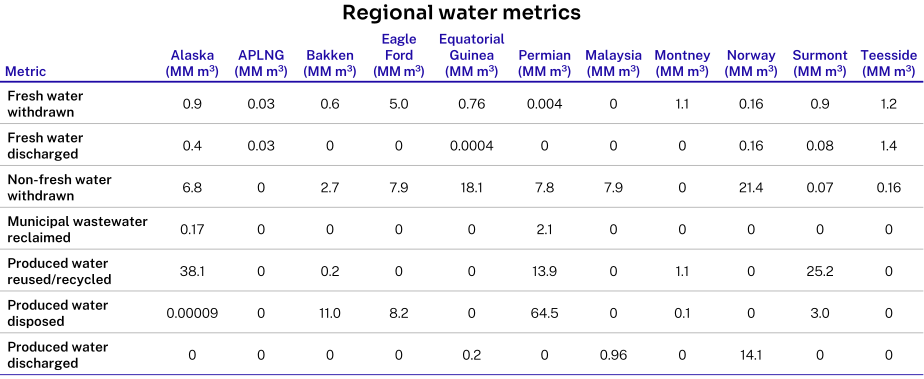
We measure and report the volume of fresh water1 and non-fresh2 water withdrawn, the volume of municipal waste water reused, and the volume of produced water3 that is reused, recycled, disposed or discharged after treatment. The data is used to estimate our fresh water consumption4 intensity and exposure to water stress.
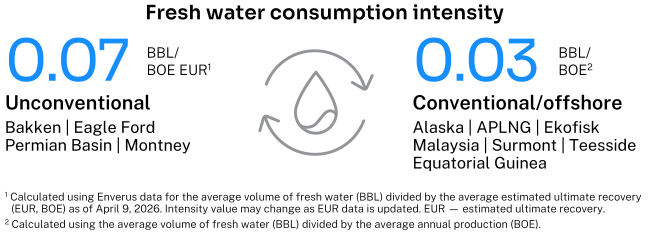
Exposure to water stress
We use the World Resources Institute Aqueduct Risk Atlas to complete a screening level assessment of our portfolio exposure to water stress. For select assets we also verify the level of water stress using local water supply and demand data for a more detailed understanding.
Operated assets located within areas of high baseline water stress in 2025 included parts of the Permian Basin and parts of the Eagle Ford. Overall, 13.7% of our fresh water withdrawal and 17.0% of our fresh water consumption was in regions of high water stress.
Notes:
- Regulatory definitions of fresh water can range from less than 1,000 to less than 4,000 milligrams per liter total dissolved solids (TDS). ↩
- Non-fresh water includes brackish/saline groundwater ranging between 2,000 to more than 10,000 milligrams per liter TDS and seawater with about 35,000 milligrams per liter TDS. ↩
- Produced water ranges from less than 10,000 to more than 300,000 milligrams per liter TDS. ↩
- Calculated as total fresh water withdrawn minus total fresh water discharged. ↩