
We explore for, develop and produce crude oil and natural gas globally.
We explore for, develop and produce crude oil and natural gas globally.
For Investors
News & Media
ConocoPhillips announces winners of 2023 Supplier Recognition Award program
March 26, 2024ConocoPhillips announces Dominic Macklon to retire after 33 years with the company
February 15, 2024ConocoPhillips to Hold Fourth-Quarter Earnings Conference Call on Thursday, Feb. 8
December 19, 2023Annual Meeting of Stockholders
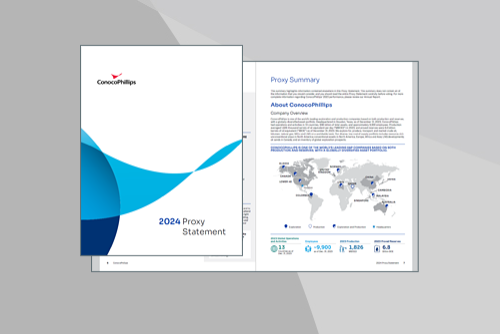
The ConocoPhillips 2024 Annual Meeting of Stockholders will be held virtually on May 14, 2024.
2022 Sustainability Report
Our work in 2022 included projects that minimized environmental risk and impact, while benefiting communities.


2022 Human Capital Management Report (HCM)
This report details the actions we are taking to inspire a compelling culture, attract and retain great people, provide rewarding opportunities and meet our commitments to all stakeholders.
Paris-Aligned Climate Risk Strategy
We have adopted a comprehensive framework with an ambition to become a net-zero company for operational emissions by 2050.
spiritnow Stories
Our online publication provides readers with a closer look into every aspect of the company.
Power in Cooperation
Power in Cooperation exists to build common ground around smart energy solutions. It is an advocacy community made up of ConocoPhillips employees, retirees, partners, neighbors and friends.


Invested in Communities
To be a good corporate citizen, we must first be good neighbors.


Worldwide Operations
We explore for, produce, transport and market crude oil, bitumen, natural gas, natural gas liquids and liquefied natural gas on a worldwide basis
Alaska
ConocoPhillips is Alaska’s largest crude oil producer and largest owner of exploration leases, with approximately 1.2 million net undeveloped acres at year-end 2022.
Australia
ConocoPhillips has been active in Australia for two decades and serves as operator of the Australia Pacific LNG liquefaction plant in Queensland.
Canada
The ConocoPhillips Canadian operations are comprised primarily of Surmont in the Athabasca region of northeastern Alberta and the Montney unconventional development in British Columbia.
China
In China, the company holds interests in producing fields in Bohai Bay and the South China Sea.
Colombia
ConocoPhillips is concentrating on international exploration opportunities that provide both scale and flexibility, with international new venture activity ongoing in Chile and Colombia.
Houston
ConocoPhillips is an independent exploration and production (E&P) company headquartered in Houston, Texas.
Libya
In Libya, the company has an interest in the Waha Concession in the Sirte Basin.
Lower 48
The Lower 48 represents the largest ConocoPhillips business segment today based on production, with high-quality positions in the U.S. unconventionals. These low cost of supply and low GHG-intensity assets have significant upside potential.
Malaysia
ConocoPhillips' involvement in Malaysia began in 2000 and consists of interests in six blocks in varying stages of exploration, development and production.
Norway
ConocoPhillips has a significant production and exploration position in the Norwegian sector of the North Sea.
Qatar
ConocoPhillips holds interest in Qatargas 3, a large-scale LNG liquefaction and export project operated by Qatar Petroleum and located in Ras Laffan Industrial City, Qatar.


Alaska
ConocoPhillips is Alaska’s largest crude oil producer and largest owner of exploration leases, with approximately 1.2 million net undeveloped acres at year-end 2022.

Australia
ConocoPhillips has been active in Australia for two decades and serves as operator of the Australia Pacific LNG liquefaction plant in Queensland.

Canada
The ConocoPhillips Canadian operations are comprised primarily of Surmont in the Athabasca region of northeastern Alberta and the Montney unconventional development in British Columbia.

China
In China, the company holds interests in producing fields in Bohai Bay and the South China Sea.

Colombia
ConocoPhillips is concentrating on international exploration opportunities that provide both scale and flexibility, with international new venture activity ongoing in Chile and Colombia.

Houston
ConocoPhillips is an independent exploration and production (E&P) company headquartered in Houston, Texas.

Libya
In Libya, the company has an interest in the Waha Concession in the Sirte Basin.

Lower 48
The Lower 48 represents the largest ConocoPhillips business segment today based on production, with high-quality positions in the U.S. unconventionals. These low cost of supply and low GHG-intensity assets have significant upside potential.

Malaysia
ConocoPhillips' involvement in Malaysia began in 2000 and consists of interests in six blocks in varying stages of exploration, development and production.

Norway
ConocoPhillips has a significant production and exploration position in the Norwegian sector of the North Sea.

Qatar
ConocoPhillips holds interest in Qatargas 3, a large-scale LNG liquefaction and export project operated by Qatar Petroleum and located in Ras Laffan Industrial City, Qatar.