Biodiversity

Our operated assets span a wide range of ecoregions, including deserts, forests, grasslands, savannas, tundra, and marine environments. Biodiversity management priorities vary by location and are shaped by ecological conditions, regulatory requirements, land use, proximity to sensitive habitats or species, and community expectations. Together, these factors inform how biodiversity impacts, risks and opportunities are managed.
Mitigation hierarchy
We manage biodiversity impacts through a structured application of the mitigation hierarchy, a decision-making framework that prioritizes mitigation actions in the following sequence: avoid, minimize, restore and offset. This hierarchy guides how we evaluate potential ecological effects and select appropriate mitigation measures throughout the life cycle of our operations.
Avoid
Some biodiversity impacts can be avoided through careful spatial or temporal placement of infrastructure and construction activities, design optimization or scheduling field activities outside peak migration or breeding seasons. The examples in the table highlight mitigation measures implemented at selected operated assets over recent years, reflecting site‑specific operational practices shaped by local conditions.
| Sensitive species, habitats or ecosystems |
|
| Physical footprint |
|
| Research and monitoring |
|
Minimize
We minimize biodiversity impacts through measures taken to reduce the duration, intensity and/or extent of the spatial footprint of our operations. The examples in the table highlight mitigation measures implemented at selected operated assets over recent years, reflecting site‑specific operational practices shaped by local conditions.
| Sensitive species, habitats or ecosystems |
|
| Physical footprint |
|
| Research and monitoring |
|
Restore
When impacts and disturbance cannot be avoided or further minimized, we focus on restoring affected areas through reclamation activities aimed at re‑establishing stable, productive and self‑sustaining ecosystems, while considering beneficial uses of the affected and surrounding landscapes. The examples in the table highlight mitigation measures implemented at selected operated assets over recent years, reflecting site‑specific operational practices shaped by local conditions.
| Sensitive species, habitats or ecosystems |
|
| Physical footprint |
|
| Research and monitoring |
|
Offset
Biodiversity offsets may be used to address residual impacts that remain after avoidance, minimization and restoration measures have been implemented, or where required by regulation. The examples in the table highlight mitigation measures implemented at selected operated assets over recent years, reflecting site‑specific operational practices shaped by local conditions.
| Sensitive species, habitats or ecosystems |
|
| Physical footprint |
|
| Research and monitoring |
|
Indicators and metrics
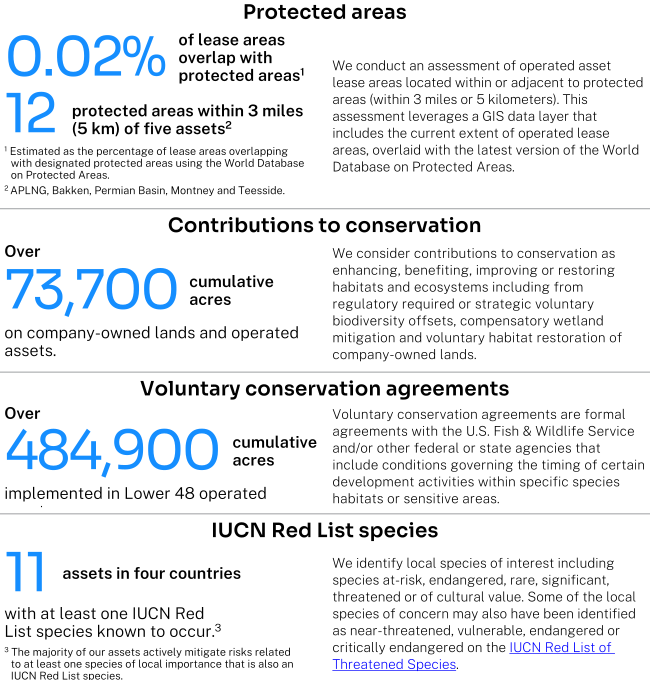
We collect data and information related to species occurrence and sensitive habitats located within or adjacent to our operated assets. We focus on species characterized as at-risk, endangered, rare, significant, threatened or of cultural value, and habitats characterized as sensitive by local regulators or conservation organizations as well as the International Union for the Conservation of Nature (IUCN) I-VI protected areas. Data and information are used to develop indicators related to protected areas, conservation and the IUCN Red List of Threatened Species. The information is used to inform work plans and risk assessments.