Scope 1 and Scope 2 emissions reduction activities
Marginal abatement cost curve (MACC) process
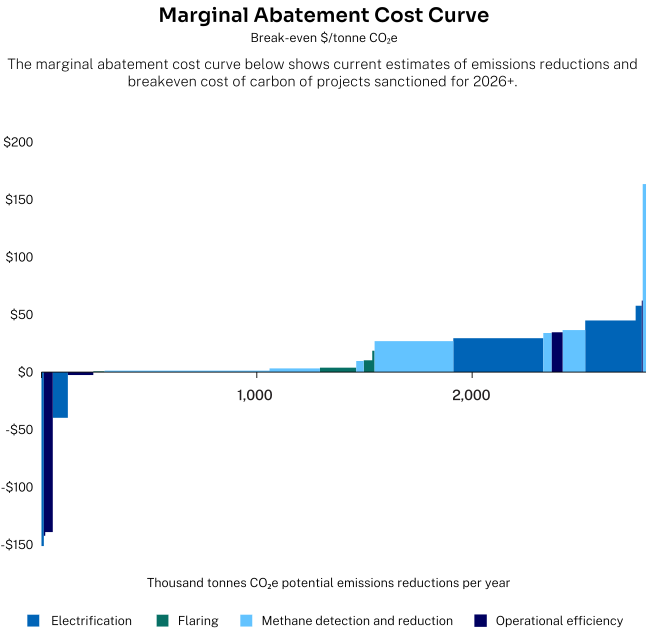
During our annual budget planning process, we use the MACC process to collect potential operational greenhouse gas (GHG) emissions reduction projects from our business units (BUs), prioritize them based on their cost and reduction volume, and implement the most cost-effective projects. The MACC plots the break-even cost of carbon dioxide equivalent (CO2e) reduction, considering capital and operating cost, and the potential increased revenue for each project against the cumulative GHG emissions that can be reduced.
Project funding may be based on criteria including but not limited to:
- Regulation: Existing or anticipated.
- Cost efficiency: Cost per tonne of CO2e abated.
- Durability: Reduces emissions permanently.
- Adoption readiness: Reliable technology, systems and processes proven to reduce emissions by the forecasted amount.
- Strategic: Scalability, repeatability, timing, risk and other means of justification.
We typically consider projects that are expected to provide the greatest overall contribution in reducing our GHG emissions with a break-even cost of below $60/tonne CO2e, as well as projects that anticipate forthcoming regulatory changes. By prioritizing and confirming projects through the MACC process, BUs are able to embed emissions reduction efforts within their budgets and long-range plans (LRPs). Our goal is to allow innovation, flexibility and accountability at the local level while providing support, guidance and oversight from corporate peers. This approach allows BUs to reprioritize and adjust within their budgets to account for regulatory and/or technology changes while maintaining consistency in process.
ConocoPhillips supports emissions reduction projects across our global operations through the MACC. These projects address improvements relating to methane and flaring, electrification, process optimization, efficiency, and include strategic pilots and studies. We prioritized methane and flaring projects in support of our methane and flaring initiatives.
- Methane venting: Eliminate natural gas-driven pneumatics and modify facilities to reduce natural gas venting.
- Flaring: Eliminate flares where possible; incorporate vapor recovery units at facilities where economically and technically viable; recover waste gas for sales.
- Electrification: Reduce combustion needs on drilling and completions; electrify operations and pursue renewable energy sources where viable and economic.
- Optimization and efficiency: Streamline process equipment and facilities, tanks and equipment; improve waste heat utilization, insulation and power distribution. Consolidate older tank battery facilities to modern facilities to take advantage of existing emissions control equipment while improving operating efficiency.
To progress projects and achieve reductions in these areas, we have set up regional teams in North America, Australia, China and Europe to use the MACC process. Operational GHG emissions management is an expected core competency for our BUs managing oil and gas production. Those BUs are required to review their GHG emissions profile and identify opportunities to enable design and operating improvements that can reduce emissions. Output from the MACC informs our annual budget, LRP and technology strategy.
In 2025, we spent approximately $200 million on Scope 1 and Scope 2 emissions reductions.1 Emissions reduction activities resulted in approximately 0.4 million tonnes per annum (MTPA) in CO2e reductions across our global portfolio.
Projects below the line are economic and have a negative break-even cost of carbon.2 Projects above the line are not economic without considering cost of carbon — the taller the bar, the higher the break-even cost of carbon. The width of the bar indicates the annual operational emissions abatement that would occur should the project be undertaken — the wider the bar, the greater the emissions abated.
We participate in The Environmental Partnership, a coalition of about 100 oil and natural gas API member companies working to improve methane emissions management.
A summary of select emissions reduction projects is provided in the tables below.
Methane and emissions detection technologies
| Category | Program Details | Highlighted Region | |
|---|---|---|---|
| Engineering and Design | Eliminating gas-driven pneumatic devices | Multiyear program to retrofit pneumatic devices to reduce methane emissions and maintain regulatory compliance and anticipated federal guidelines. | Lower 48 |
| Brownfield and greenfield facilities | Use supplied air instead of produced gas at greenfield (new) facilities to reduce natural gas emissions from pneumatics. | ||
| Improve wellpad and central facility design to reduce GHG emissions, with the potential installation of vapor recovery units or removal of tanks and flares. | |||
| Installation of welded pipelines to avoid flanged connections and minimize leaks. | Alaska | ||
| Detection | Fixed wing aircraft aerial methane detection | Utilize aircraft flyovers to identify and minimize fugitive emissions. | Lower 48 |
| Voluntary leak detection and repair (LDAR) | Utilize periodic ground-based and/or drone optical gas imaging (OGI) to further identify and reduce fugitive emissions. | Lower 48 and Malaysia | |
| Compliance driven leak detection and repair (LDAR) |
Identify and repair leaking components to reduce GHG emissions and maintain regulatory compliance by following federal and other state regulations. | Lower 48 and Alaska | |
| Audio, Visual, or Olfactory (AVO) inspections | Frequent inspections as part of routine duties, regulatory requirements, or in response to operational issues to identify potential leaks. | ||
| Monitoring | Monitors on some drilling rigs | Monitoring diesel fuel and natural gas consumption, and engine loads to allow for optimization via battery banks yielding diesel usage and GHG reductions. | Canada |
| Predictive Emission Monitoring System (PEMS) | Installed PEMS on gas turbines for more accurate accounting of noncombusted methane. | Norway | |
Flaring
| Category | Objective | Program Details | Highlighted Region |
|---|---|---|---|
| Engineering and Design | Reduce field flaring | Treatment of sour gas, increase of VRU runtime, de-bottlenecking and auto-curtailment when offtake is restricted. | Lower 48 |
| Decommissioning of tanks and flares, commingling fluids and processing at larger central facilities. | |||
| Build and operate a gathering system which enables more connections to multiple third-party processors to manage offtake constraints. |
Operational efficiency
| Objective | Program Details | Highlighted Region |
|---|---|---|
| Reduce GHG emissions intensity | Advanced development and planning activities for energy-efficient steam use. Initial field execution concluded. | Canada |
| Piloted steam additive technology to explore reductions in steam-to-oil ratios. | ||
| Reduce operational GHG emissions |
Advancing installation of automation measures (auto adjust burner mode) on gas export turbines and new generator control panel. | Norway |
| Advancing rebundling of gas lift compressor to reduce emissions from pipeline compressors. | ||
| Utilizing waste heat from power generation turbines to provide building and process heat. | Alaska | |
| Reduce Scope 2 emissions | New crude charge pump installed and in service. | Teesside |
| Efficient Operation |
Increased power cable capacity allowing exchange of more power between Ekofisk and Eldfisk. | Norway |
| Energy and fuel savings | Construction commenced of power island, using ethane as fuel to provide electricity for the terminal and export excess to U.K. grid. | Teesside |
| Continuing steam boilers burner management system rationalization to deliver fuel and emissions savings. |
Electrification and alternative power
| Category | Initiative | Program Details | Highlighted Region |
|---|---|---|---|
| Drilling and Completions | Drilling rig and hydraulic fracturing fleet conversions | Use of compressed natural gas and field gas to reduce diesel consumption and improve fuel efficiency. | Lower 48 |
| Partnering with suppliers | Use of electrified conveyer belt for proppant delivery, reducing traffic-related emissions while enhancing supply chain efficiency through local sand sourcing. | ||
| Electrification | Rig connection to grid, when available | Nearly eliminate diesel power generation. | Lower 48 |
| Long-term strategy to use power from grid | Transmission Service Providers (TSPs) and the Electric Reliability Council of Texas (ERCOT) continue to advance planning and construction of grid infrastructure projects, including new 765 kV import lines into the Permian Basin to alleviate constraints on demand growth. | ||
| Connection to onshore power grid |
Completed the electrification at all 10 diesel-powered platform rigs to nearly eliminate diesel power generation. Reduces need to purchase natural gas from local market with the coming power from shore project; overall reduction in absolute emissions. |
China | |
| Montney Greenfield Electrification initiative | Ongoing project to electrify CPF3 and future central processing facilities. In 2024, project to construct 140 kilometers of high-voltage transmission infrastructure was commenced. |
Canada | |
| Alternative power | Solar Farm | Generated first power in Q3 2024 on a 10 MW project in Midland Basin; provides renewable energy directly to our operations. A 20MW behind-the-meter project in Delaware Basin is in progress. 8MW is currently online with the additional 12 MW coming online in 2026. |
Lower 48 |