| Key Facts |
Employees: 1,825 Total Average Daily Production in 2007: 209 MBOE
- Oil: 162 MBD
- Gas: 236 MMCFD
- NGL: 8 MBD
Major Office Locations: Tananger |
Exploration and Production ConocoPhillips’ history in Norway began in the early 1960s when the ConocoPhillips now has an expanded production and exploration company (in partnership with Agip and Fina) was awarded three position in the Norwegian sector of the North Sea. In addition to the production licenses. A successful discovery in 1969 led to the Greater Ekofisk area, ConocoPhillips also has ownership interests in commissioning of Ekofisk, the first commercial oil field in the several nonoperated assets. An exploration effort will continue on Norwegian North Sea. Production on Ekofisk started in 1971 and is some of the more prospective offshore acreage blocks. the cornerstone to the company’s Norwegian portfolio.
ConocoPhillips now has an expanded production and exploration position in the Norwegian sector of the North Sea. In addition to the Greater Ekofisk area, ConocoPhillips also has ownership interests in several nonoperated assets. An exploration effort will continue on some of the more prospective offshore acreage blocks.
Greater Ekofisk Area (Equity interests exclude Tor) Operator: ConocoPhillips (35.1%) Co-venturers: Total E&P Norge (39.9%), Eni Norge (12.4%), Others (12.6%)
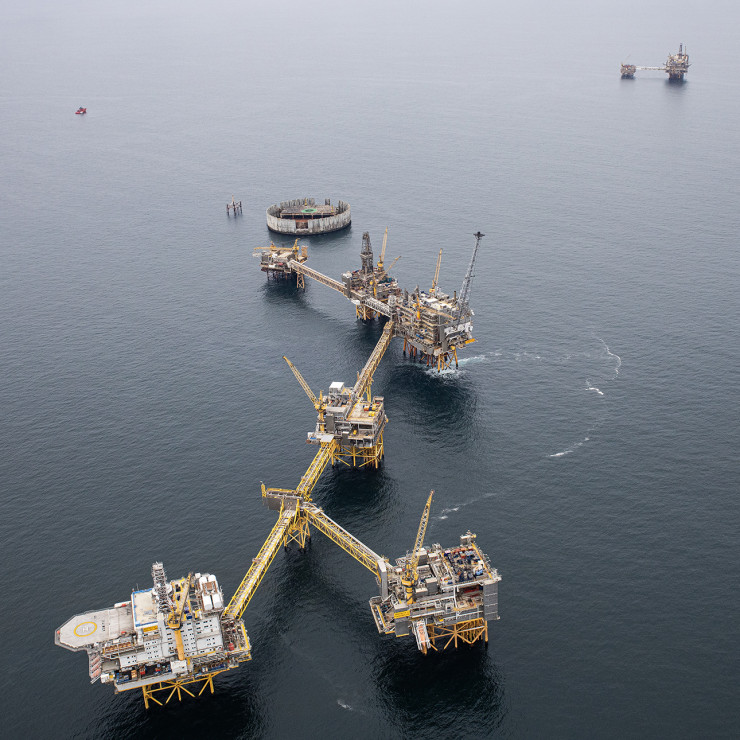
The Greater Ekofisk area is comprised of four producing fields: Ekofisk, Eldfisk, Embla and Tor. The Ekofisk complex is located 200 miles offshore Stavanger, Norway. Since first production in 1971, technology has been used to increase production and extend the economic life of the field. Ekofisk serves as a hub for petroleum operations in the area, and surrounding developments utilize the Ekofisk infrastructure. Ekofisk oil is exported to Teesside, England, and the natural gas is exported to Emden, Germany.
In 2003, a project was undertaken to further develop the Greater Ekofisk area. The project included the construction of a new wellhead platform, Ekofisk 2/4M, and modification of the existing Ekofisk and Eldfisk complexes to increase processing capacity. The platform was installed in 2004, and first production was achieved in October 2005.
Eldfisk field consists of two production platforms. Water injection at Eldfisk has resulted in increased production and recoverable reserves. A series of projects currently is being studied to provide a foundation for future Norway operations, including a new Ekofisk accommodation and several new platforms for expanded water injec¬tion and exploitation of additional resources. Net production from the Greater Ekofisk area during 2007 was 99 MBD of crude oil, 103 MMCFD of natural gas and 4 MBD of NGL.
Heidrun Operator: Statoil Hydro (12.4%) Co-venturers: Petoro (58.2%), ConocoPhillips (24.3%), Eni Norge (5.1%)
The Heidrun field is located in the Norwegian Sea and is an integrated development. Oil from the field is transported to Mongstad in Norway and Tetney in the United Kingdom by double-hulled shuttle tankers. Part of the natural gas is transported and sold to buyers in Europe, and part is used as feedstock in a methanol plant in Norway, in which ConocoPhillips has an 18.1 percent interest. ConocoPhillips discovered and developed the field and turned operatorship over to Statoil in 1995. Net production in 2007 was 26 MBD of crude oil and 18 MMCFD of natural gas.
Statfjord Operator in Norwegian sector of the field: StatoilHydro (44.3%) Operator in U.K. sector of the field: ConocoPhillips (15.2%, of which 10.3% is in the Norwegian sector, 4.8% is in the U.K. sector) Co-venturers: ExxonMobil Norway (21.4%), Norske Shell (8.6%), Others (10.5%)
The Statfjord field was discovered in 1973 and straddles the boundary between Norway and the United Kingdom. It was developed with three integrated platforms supported by gravity-base structures featuring concrete storage cells. Oil and natural gas from the Snorre, Sygna, Statfjord East and Statfjord North fields are processed and transported from the Statfjord installations. In order to extend the production life of the field, the Statfjord Late Life Project is under way to transform the field from an oil producer to a natural gas producer with associated oil. The project’s development and operation application was approved by the Norwegian and U.K. authorities in 2005. The project is expected to extend the field’s life to 2016. The production and export of the Statfjord Late Life gas to the U.K. transportation system started in October 2007. Net production in 2007 was 13 MBD of crude oil, 22 MMCFD of natural gas and 3 MBD of NGL.
Huldra Operator: StatoilHydro (19.9%) Co-venturers: Petoro (32.0%), Total E&P Norge (24.3%), ConocoPhillips (23.3%), Others (0.5%)
Huldra is a natural gas and condensate field located north of the Oseberg area. It is remotely controlled from the Veslefrikk platform. Condensate is transported via pipeline to Veslefrikk B for processing and is transported to the Sture terminal near Bergen through the Oseberg Transportation system, and gas is piped to Heimdal for processing and transportation through Gassled. A booster compressor facility to stem the decline of flowing wellhead pressure became oper¬ational in mid-2007. The field’s life is expected to be extended until 2011. Net production in 2007 was 1 MBD of crude oil and 17 MMCFD of natural gas.
Troll Operators: StatoilHydro (20.8%), Norsk Hydro (9.8%) Co-venturers: Petoro (56.0%), A/S Norske Shell (8.1%), Total E&P Norge (3.7%), ConocoPhillips (1.6%)
Troll East is northwest Europe’s largest offshore natural gas field, while Troll West is one of Norway’s largest oil and natural gas producing fields. Production drilling is ongoing on Troll West to further develop the oil reservoirs. Methods to produce more oil from Troll West and more natural gas from Troll East are being studied. Net production in 2007 was 3 MBD of crude oil and 56 MMCFD of natural gas.
Grane Operator: StatoilHydro (38.0%) Co-venturers: Petoro (30.0%), Esso E&P Norway (25.6%), ConocoPhillips (6.4%)
Grane is located 124 miles west of Stavanger. It was developed using an integrated processing, drilling and accommodation platform. Its stabilized oil is transported via pipeline to the Sture onshore terminal. Production from the field started in September 2003. Net production in 2007 was 13 MBD of crude oil.
Oseberg Area Operator: StatoilHydro (49.3%) Co-venturers: Petoro (33.6%), Total E&P Norge (10.0%), Mobil Development Norway (4.7%), ConocoPhillips (2.4%)
The Oseberg area is located west of Troll. It was developed with four producing platforms, two processing platforms and a number of subsea installations. Oil is transported from the Oseberg field center to Sture through the Oseberg Transportation System, and natural gas is transported through the Oseberg Gas Transport to Heimdal.
Alvheim Operator: Marathon (65.0%) Co-venturers: ConocoPhillips (20.0%), Lundin Oil (15.0%)
The Alvheim development consists of a floating production, storage and offloading vessel and subsea installations. Produced oil will be exported via shuttle tankers, and rich natural gas will be transported to the United Kingdom via a new pipeline to the Beryl-Sage system. The development and operation plan was approved by the Norwegian authorities in October 2004, and development drilling started in early 2006. First production was in July 2008.
Visund Operator: StatoilHydro (53.2%) Co-venturers: Petoro (30.0%), ConocoPhillips (9.1%), Total (7.7%)
Located in the Tampen area, the Visund field is a subsea development tied into a floating drilling, production and accommodation unit. Oil production started in 1999. The oil is transported by pipeline to Gullfaks A and then offloaded to tankers. Natural gas exports through the Kvitebjørn/Troll system to Kollsnes began in late 2005.

Norway Facilities Norpipe Oil Pipeline System Operator: ConocoPhillips (35.1%) Co-venturers: Total E&P Norge (34.9%), Statoil (15.0%), Others (15.0%)
This 220-mile North Sea pipeline carries crude oil from Ekofisk to a large terminal and NGL processing facility at Teesside, England. The pipeline has a net capacity of 900 MBD of crude oil and serves several fields in Norway and the United Kingdom, including the J-Block development in the U.K. sector of the North Sea.
Norwegian Continental Shelf (NCS) Gas Transportation (Gassled) Operator: Gassco A/S Co-venturers: Petoro (38.3%), Statoil (20.4%), Norsk Hydro Produksjon (11.1%), ConocoPhillips (2.2%), Others (28.0%)
Gassled, a joint venture in which ConocoPhillips is a co-venturer, owns the gas transportation infrastructure on the NCS.
Marketing ConocoPhillips has marketing operations in Europe through company-owned and dealer-owned JET® branded outlets. The largest of the company’s European marketing networks are in Germany and the United Kingdom. A portion of Irish refinery production is sold to inland Irish markets.
The company’s European marketing strategy is to sell primarily through owned, leased or joint-venture retail sites using a low-cost, high-volume strategy. ConocoPhillips also markets aviation fuels, liquid petroleum gases, heating oils, transportation fuels and marine bunker fuels to commercial customers and into the bulk or spot market.
As of Dec. 31, 2007, ConocoPhillips had approximately 1,600 marketing outlets in its European operations, of which approximately 1,150 were company owned, and 450 were dealer owned. Through our joint venture operations in Switzerland, we also have interests in 196 additional sites. The company’s largest branded site networks are in Germany and the United Kingdom, which account for approximately 75 percent of our total European branded units.
During 2007, ConocoPhillips sold 377 of its fueling stations in six European countries to LUKOIL and completely divested its marketing operations in Thailand and Malaysia. As of Dec. 31, 2007, agreements were signed for the sale of Norway, Sweden and Denmark marketing assets, and are under regulatory review.

Find out more at
|