KEY POINTS
- Exploring the muddy connection between geology and Major League Baseball (MLB)
- MLB prepares at least 156 baseballs for every game, rubbing each ball with a specific mud to improve its grip and feel
- Two ConocoPhillips geologists volunteered their time and expertise to research the rubbing mud’s sedimentological characteristics and how it changes the surface of a baseball
BY GUS MORGAN
Baseball and geology?
“You bet,” said ConocoPhillips geologist Dallin Laycock, a sedimentologist committed to showing how geology shapes the world around us, even in sports like Major League Baseball (MLB).
In his spare time and as a hobby, Laycock pursues geological collaborations designed to not only advance scientific understanding but to make Earth sciences more accessible and compelling to broader audiences.
Read the study in The Sedimentary Record:
“I'm always looking for ways to make science come alive for everyone,” said Laycock, who supports the Canada business unit and actively champions STEM — science, technology, engineering and math — education.
In May, Laycock shared findings from a research study he coauthored with seven other peers, “Geology’s Grip on Baseball: A Geological Characterization of Baseball Rubbing Mud,” at GeoConvention 2025 in Calgary, a premier gathering for earth science professionals, academics and students. By early fall, the team's study was published in The Sedimentary Record, just in time for the 2025 World Series matchup between the Toronto Blue Jays and the Los Angeles Dodgers.
“This study,” Laycock said, “spotlights how sports and science can intertwine.”
It's exciting to contribute geological insights to a sport like baseball that resonates with so many people.
ConocoPhillips geologist Erin Pemberton, a dedicated STEM advocate who also volunteers her time and expertise to help with such educational projects, was one of the co-authors of the baseball study, alongside contributors from the National Aeronautics and Space Administration (NASA), Bureau of Ocean Energy Management (BOEM), Strathcona Energy and AGAT Labs.
Pemberton, who supports the Alaska business unit, is also passionate about making geoscience topics accessible and relatable beyond the scientific community, using her expertise to show how the field shapes and influences everyday life.
“This project was a perfect manifestation of that,” said Pemberton, a sedimentology and stratigraphy expert. “Analyzing sediments and interpreting the depositional environments they originate from is one of my favorite things to do. I'm also a sports fan. I grew up playing as many sports as I could, as well as watching sports during the cold Edmonton winters. So, this study felt like a natural fit, a way to connect fundamental geoscience with a major league sport.”

So, what's the connection between baseball and geology?
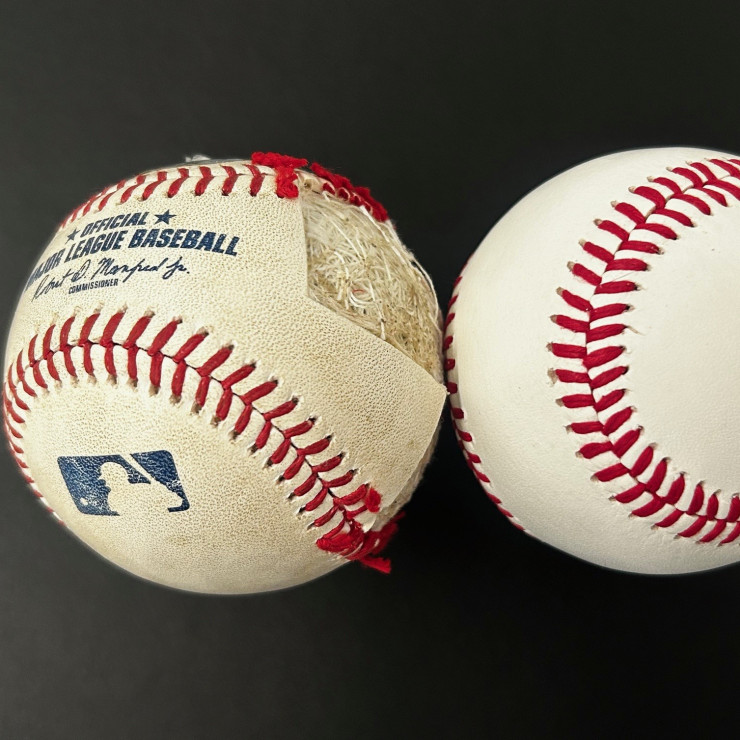
Prior to each game, MLB personnel massage at least 156 baseballs with a specially prepared mud to decrease their slickness and enhance grip, making the balls easier for both pitchers and fielders to control.
“But it’s not just any mud,” Laycock said.
The mud, known as Lena Blackburne Baseball Rubbing Mud, is sourced from a secret location on a New Jersey tributary of the Delaware River.
“As a sedimentologist and sports fan,” Laycock said, “I wanted to understand how this mud makes such a dramatic difference to the feel and performance of a baseball.”
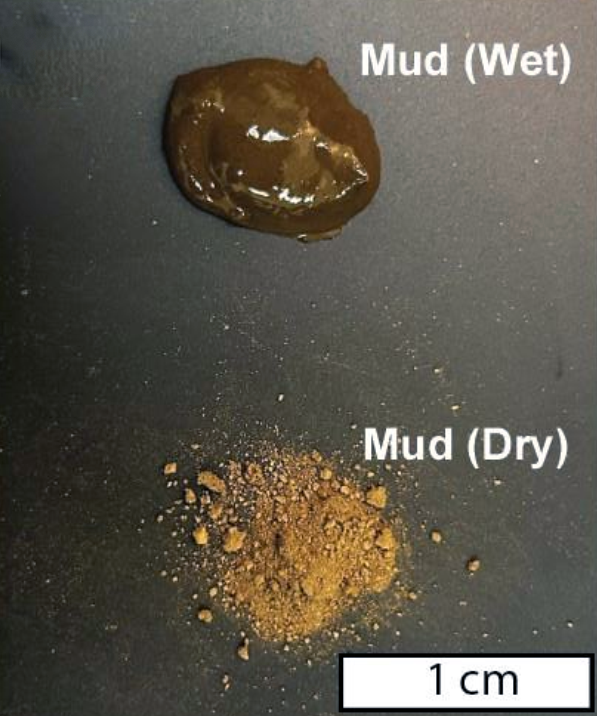
Building on earlier research, the team's study focused on the distinct geological properties of the rubbing mud, the same substance MLB has used to prepare every one of its baseballs since the 1950s.
While previous research has examined the aerodynamics of mud-treated baseballs and assessed the frictional forces between fingers and baseballs, Laycock said these studies did not sufficiently explore the specific texture, composition or effects of the rubbing mud.
Seeking to fill this gap, Laycock said they conducted a more detailed examination of the mud’s composition and its transformative impact on the baseball’s exterior, further illuminating why this unique substance has become the gold standard for Major League Baseball.
They focused on how the mud influenced a baseball’s color, abrasion and consistency, as well as the mud’s composition, grain size and color.

Three baseballs formed the core of the study: an official MLB ball used in a game on April 7, 2024; a new ball treated with the legendary Lena Blackburne mud; and a pristine control ball, untouched by mud or human hand.
The team partnered with AGAT Labs, a science lab in Calgary, to study the mud. They used three specialized tools: X-ray diffraction, a technique used to analyze the minerals present in the mud; particle size distribution analysis, which measures how big or small the grains of sediment are; and scanning electron microscopy, a process that uses a powerful microscope to show tiny details in both the mud itself, as well as the baseballs.
These tests unraveled the mud’s mysteries at a microscopic level. The results were fascinating.
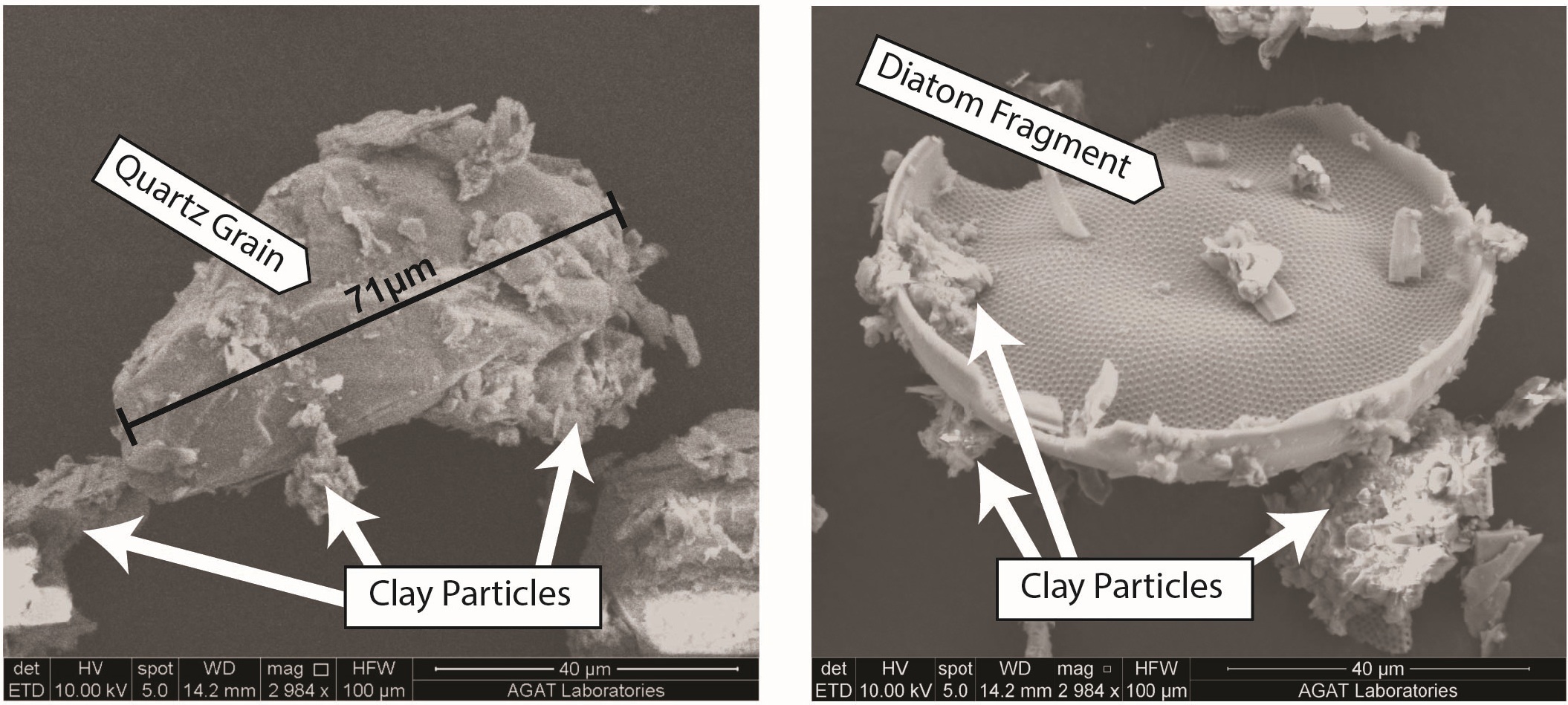
The analysis showed the mud consists mainly of a blend of fine non-swelling clay particles (53%) and quartz (42%), a hard mineral that adds grit to the mud, providing some abrasion or exfoliation to the ball. Minor amounts of microscopic algae called diatoms, and various other minerals were also present. This composition, Laycock said, gives the mud its mildly abrasive quality, giving the baseballs a consistent texture and color.
Using the scanning electron microscope on the mud-rubbed balls, the research team discovered that the pores of the leather were mostly packed with fine clay particles, with occasional common diatoms and finer quartz grains found in the pores.
“Those pore-filling clays are what give the balls their slightly darker color,” Laycock said. “The coarser quartz particles serve mostly to provide some gently exfoliation to the ball.”
The game-used ball and newly mudded ball both showed filled pores, micro-cracks and scratches in the leather. On the game-used ball, Laycock said they noticed thin layers of salt developing on its mud-filled pores, perhaps formed from a player's perspiration or due to the salinity of the brackish water where the company collected the mud.
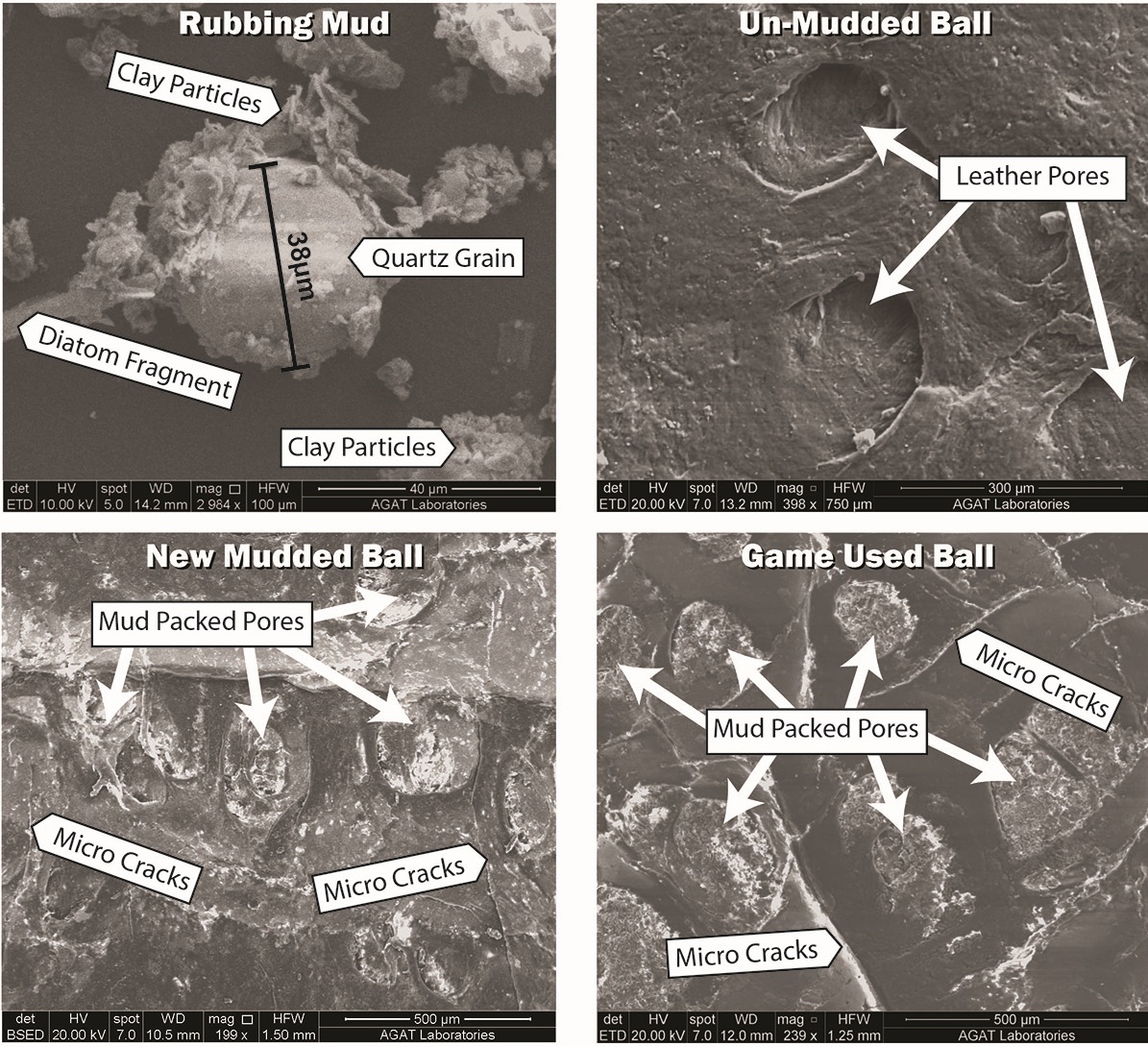
Imaging showed the mildly abrasive mud removed the baseball’s gloss, creating tiny cracks and scratches and enhancing grip without harming the ball. The clay particles also altered the baseball’s color and texture by settling into the leather’s natural pores and coating its surface, making the ball feel consistent from pitch to pitch.
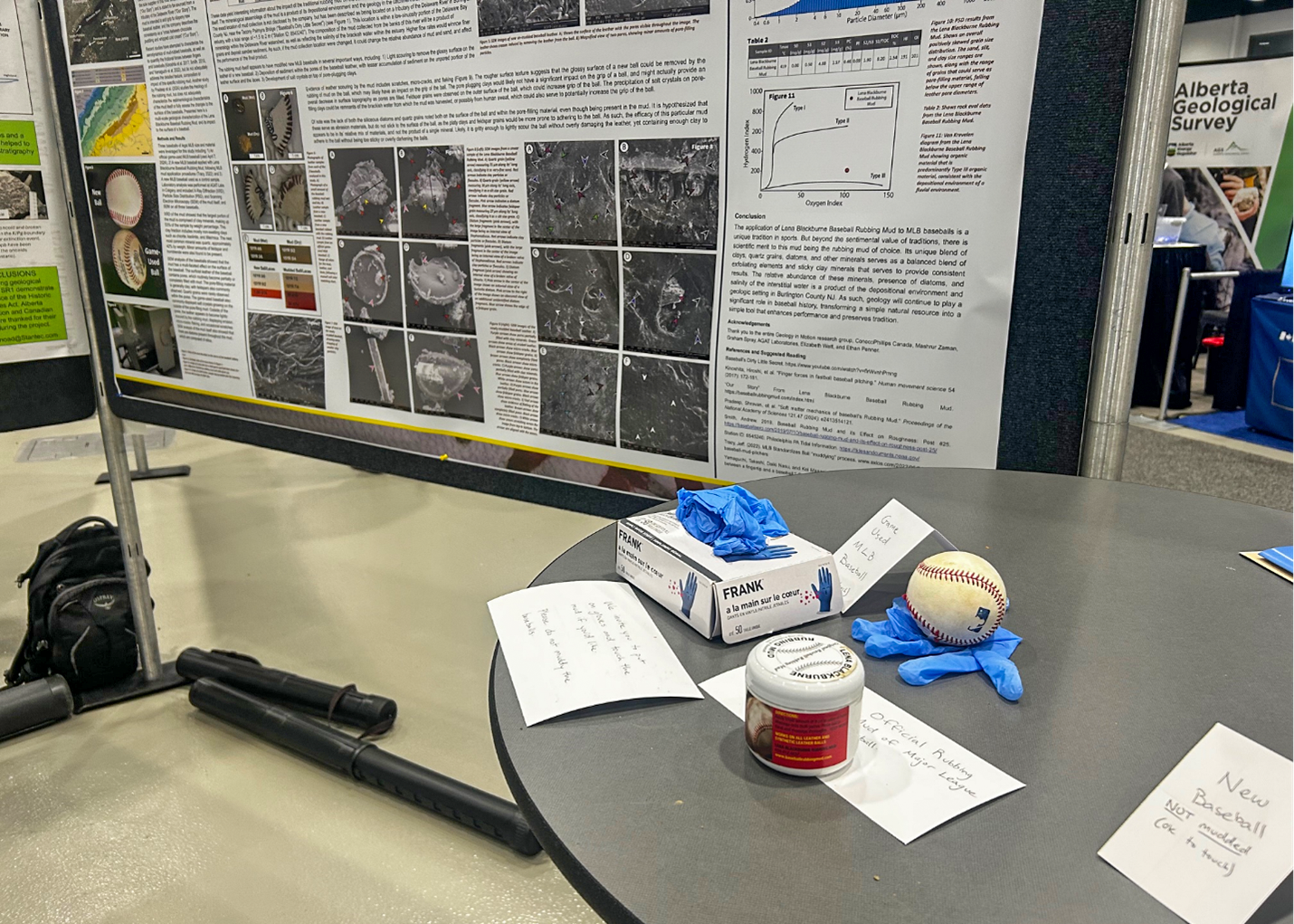
“The results show there is scientific merit to this mud being the rubbing mud of choice,” he said. “There are a few characteristics that make this mud work so well. It’s not just about adding grip. MLB doesn’t want too much grip. They don’t want too much color. They want just the right amount.”
The specific mix of quartz and clays provides a good balance of exfoliation to remove the slipperiness of a new ball and adds the right amount of color.
“Too much clay,” he said, “and it won't exfoliate enough and adds too much color. Too much quartz and it scours the leather too much, providing an unfair advantage to the pitcher in the form of enhanced grip.”

The researchers found that the lack of swelling clays is important.
“If the clays in the pores were a different type,” Laycock said. “They might swell and become slippery in the presence of sweat or water. If you had every ballpark provide their own mud, there would be disparities in the feel and look of the ball, which would induce competitive inconsistencies.”
Laycock said another fascinating aspect is the geologic context of the river where the mud is collected. The grain sizes of the sediment are heavily influenced by the river's flow rate, which fluctuates throughout the year, and can vary throughout the area.
“So, it's interesting that the company collects the mud only in the summer,” he said, “and from the same location. This helps control for natural variation in the mud deposition.”
The fun factor: Connecting STEM with sports
Far from being just technical experts, many ConocoPhillips employees — like Dallin Laycock and Erin Pemberton — are passionate sports enthusiasts as well. Their dual interests help bridge the gap between the excitement of the game and the intrigue of scientific exploration.

“Erin and I want everyone, especially students, to know that STEM isn’t just for the classroom — it’s everywhere,” Laycock said. “Sports are something everyone can relate to.”
STEM education, Pemberton said, lays the foundation for tomorrow's breakthroughs.
“STEM fields drive advances in energy, medicine, communication, infrastructure and countless aspects of modern life,” she said. “It's important to show the many applications of technical thinking (down to the impact on baseball) and to make sure as many people as possible have awareness of these fields. Diverse thinking is critical to driving innovation and solving complex problems.”