Key points
- Horseshoe wells combine two laterals into a single U‑shaped wellbore, reducing the number of surface locations required and helping recover hydrocarbons that might otherwise remain stranded.
- Recent Eagle Ford pilot projects set new technical records and demonstrated that this extended-lateral design can be executed safely and reliably in deep, complex units.
- Horseshoe wells add another disciplined development option to the Lower 48 toolkit, improving capital efficiency and enabling development of challenging inventory.
In the Eagle Ford, ConocoPhillips is applying new approaches to develop complex units more efficiently.
The recent deployment of horseshoe wells — extended laterals drilled in a U-shaped configuration — is helping reduce costs and reach resources that are difficult to access with traditional designs. Horseshoe wells are one of several tools the Lower 48 business unit uses to optimize development across its unconventional portfolio.
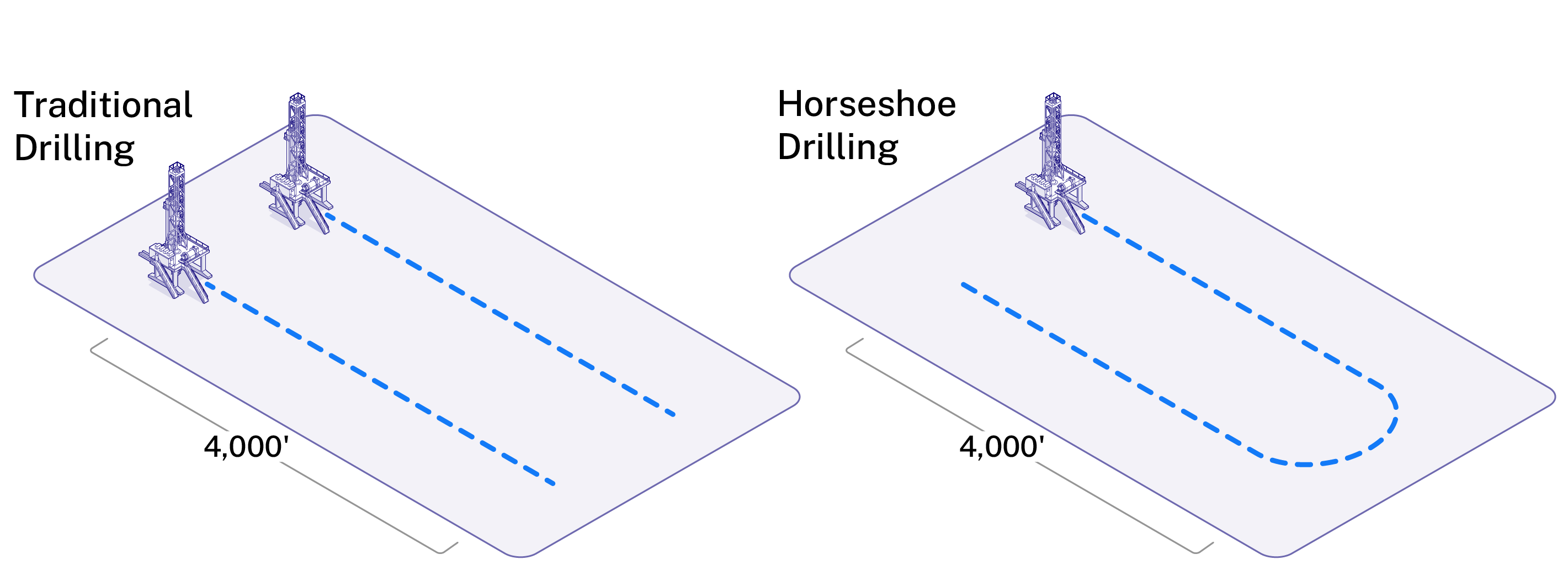
Traditionally, developing complex or stranded units meant drilling multiple wells, each with its own surface location and associated costs. Horseshoe wells combine two laterals into a single drilling event, creating one continuous, curved wellbore instead of two separate wells.
This approach reduces drilling and completion costs, minimizes surface footprint and maximizes reservoir contact, particularly in areas with deep targets, faulting or irregular unit shapes.
Eagle Ford projects demonstrate the economic value of horseshoe wells
- Significant cost savings and capital efficiency: By replacing multiple short, straight wells with fewer, longer horseshoe wells, ConocoPhillips reduced total well count, accelerated development timelines, lowered environmental impact by reducing the number of surface locations, captured comparable resource volumes, and saved tens of millions of dollars in capital expenditures on key projects.
- Improved resource recovery and project economics: Horseshoe wells increase reservoir contact in geologically complex or constrained areas, lowering cost-of-supply by an estimated $10–$15 per barrel of oil equivalent (BOE) and delivering multi-million-dollar increases in net present value compared with traditional designs.
- Enabling development of challenging inventory: This approach allows ConocoPhillips to efficiently develop units that would otherwise be uneconomic or stranded because of faults, irregular lease geometry or other constraints, unlocking value in the Eagle Ford and potentially beyond.
Tested in South Texas asset
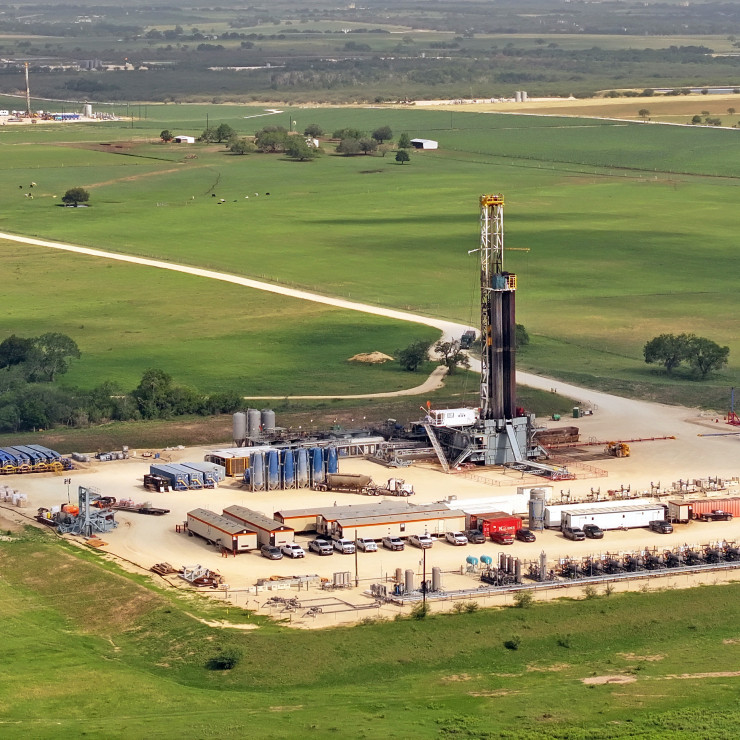
The Eagle Ford team recently completed two horseshoe well projects in areas where faults or lease geometry would otherwise have forced short laterals or left hydrocarbons stranded. The projects resulted in a total of four horseshoe wells.
These wells pushed the technical limits for deviated wellbore limits, including a basin-record completed lateral length well.
The team overcame challenges such as tight stacking and spacing, deep targets, and high dogleg severity, demonstrating that horseshoe wells can be successfully executed even in the most demanding environments.
Performance gains, well by well
"Taking what we learned from the very first horseshoe well to the three stacked horseshoe wells, it was impressive to see our performance improve so significantly across the stacked wells as the team quickly refined its approach, shifting from inclination‑based to azimuth‑based curve execution," said Eagle Ford Drilling Engineering Supervisor Spencer Morgan. "I was particularly proud of the strong collaboration, communication and execution across the team, whose timely adjustments and target shifts effectively mitigated anti-collision risk and enabled consistent well‑to‑well improvement."
Turning challenging units into viable opportunities
“Horseshoe wells are a more cost-effective tool in our toolbox to develop challenging units,” said Trevor Hurd, development geologist. “We’re able to bring previously uneconomic projects back into the plan.”
From a production standpoint, the wells have performed in line with expectations and comparable to standard long laterals.
“The performance met our authorization for expenditure expectations and delivered significant cost savings," said Nan Zhao, reservoir engineer.
Chemical tracers confirmed that the entire wellbore on one of the test wells contributed to production, including stages completed through the turn, according to geochemist Yishu Song.
“As these extended‑lateral designs evolve and mature, they will open up new opportunities for economic success,” said Chad Darneal, reservoir engineer.
Scaling the approach across the Lower 48
ConocoPhillips is now evaluating where horseshoe well designs can be applied beyond the Eagle Ford, with the goal of extending these drilling and completion efficiencies across the broader Lower 48 portfolio.
By incorporating horseshoe wells as a scalable development option, the company aims to unlock incremental value, drive sustainable capital efficiency and support disciplined, technology‑driven growth in its unconventional resource plays.
ConocoPhillips sees horseshoe wells as a scalable tool to improve capital efficiency and returns.