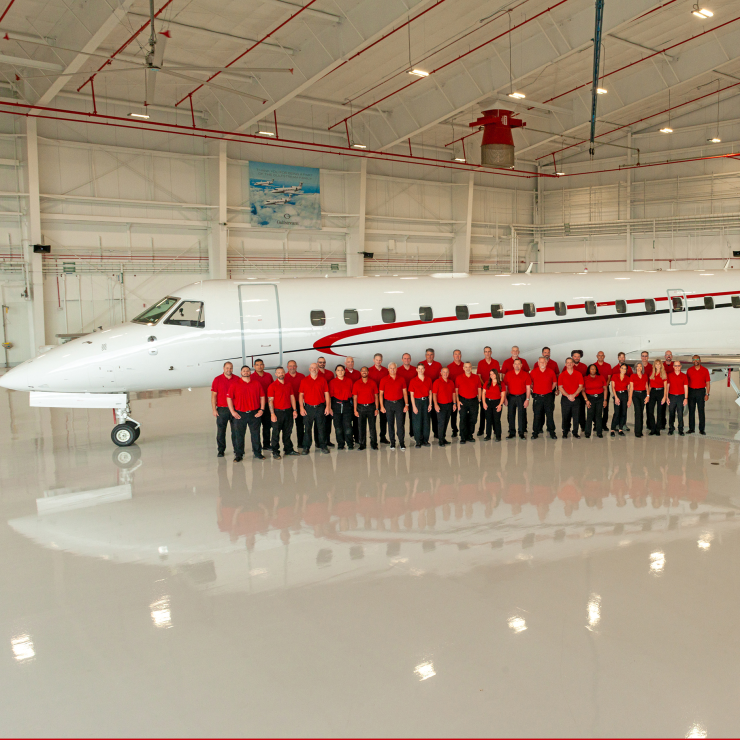
The ConocoPhillips Global Aviation team — a mix of pilots, flight attendants, maintenance technicians, operations personnel and support staff — keeps company employees, contractors and cargo moving safely and efficiently across Alaska, the Lower 48 and international destinations.
One of the aircraft the team operates is the Air Shuttle, a corporate jet designed for regional business travel. The team uses it to regularly transport workers between Houston and Midland, Texas; Carlsbad, New Mexico; Williston, North Dakota; and Bartlesville, Oklahoma.

Most days, the Air Shuttle is filled with ConocoPhillips employees heading to and from the company's various work locations. But when space permits, some of those seats are filled by cancer patients and their caregivers, traveling to Houston for care at world-class facilities such as MD Anderson Cancer Center.
Those trips are made possible through a long-standing collaboration with the Corporate Angel Network (CAN), a nonprofit organization that arranges free flights for cancer patients traveling to and from treatment centers using empty seats on corporate aircraft. Whether a patient is traveling for surgery, a clinical trial or a second opinion, CAN aims to reduce a patient’s physical, emotional and financial stress by providing seats on a corporate flight.
For more than 40 years, ConocoPhillips and its predecessor companies — Conoco and Phillips Petroleum — have partnered with CAN, turning unused Air Shuttle capacity into a lifeline for people facing cancer. Since joining the program in 1983, the company has helped more than 6,000 cancer patients reach needed medical care and treatment appointments.
How the Corporate Angel Network helps cancer patients
- Opens doors to specialized treatment that may not be available close to home
- Makes it possible to participate in clinical trials that could expand treatment options and advance medical research
- Lowers health risks by avoiding crowded commercial terminals and flights, which can be especially important for people with compromised immune systems
- Reduces the financial burden of repeated trips for treatment
- Allows family members or caregivers to travel alongside patients
- Provides support without financial qualification requirements
To learn more about the Corporate Angel Network, visit corpangelnetwork.org.
Since its founding in 1981, CAN has arranged more than 70,000 patient flights with the help of more than 500 participating corporations.
Participation is open to cancer patients and to bone marrow and stem cell donors and recipients who have a scheduled medical appointment. Eligibility is not based on financial need, and patients may travel as often as their treatment requires.
“There are just so many benefits,” said CAN Patient Services Manager Kelly Scanlon, adding that patients often get emotional when they learn CAN has secured a flight for them. “It’s like a weight has been lifted off their shoulders.”
For cancer patients with limited means, CAN flights can be the difference between getting access to specialized care options and settling for more limited care choices. That impact is why CAN's partnership with ConocoPhillips matters so much to patients — and why it continues to earn recognition.
CAN recently presented the Global Aviation team with its 2026 Corporate Angel Award, honoring ConocoPhillips' exceptional support for CAN’s mission to help cancer patients get timely access to medical appointments and treatment options.
A culture of community service
The Global Aviation team takes immense pride in its community-focused work with CAN, said Global Aviation Manager Keith Nickles.

“Service is engrained in everything we do,” he said, adding that on a normal business day, the focus is on ensuring passengers get where they need to be safely and efficiently. “When we have a CAN patient onboard, it’s an opportunity to bring that same care and attention to a flight that carries a different kind of importance. It’s a visible and meaningful way to demonstrate what the company stands for in the communities where we live and work.”
For the crews who operate the Air Shuttle routes, Nickles said the mission often becomes deeply personal.
“Over the years, we've established relationships with every one of our CAN passengers, without exception,” Nickles said. “Our flight crews get very close to them, and we celebrate their milestones in their journeys, and we've also mourned their losses. It’s difficult when we lose one of our CAN patients. Our team notices that.”

Global Aviation employee Matt Runty reflected on the connections he forged with CAN patients during his time with the Air Shuttle program.
Now Regulatory and Publications Officer for Global Aviation – Alaska, Runty joined ConocoPhillips in 2014 as an Air Shuttle captain based in Bartlesville.
He later moved into flight-operations leadership, serving as assistant chief pilot and director of operations from 2018 to 2021 before joining the Alaska Q400 operation.
Runty said few moments were more gratifying than hearing a CAN passenger say they were finishing treatment and boarding the Air Shuttle for the last time. At other times, he said, it was heartbreaking to learn that a familiar face had become too ill to travel or had lost their battle with cancer.

On occasion, Runty also met ConocoPhillips employees and spouses who weren’t traveling for work, but for cancer care via the CAN program.
“This brought home the idea that cancer touches the lives of just about everyone in one way or another,” he said, “and once again reinforced the importance of the service we are able to provide through the Corporate Angel Network.”
Runty said the Air Shuttle flights help remove one more barrier for patients and families trying to reach critical care.
“While this may be one of the hardest times in a person’s life,” he said, “we can make it just a little bit easier on them, and I like to think that it removes one barrier to pursuing the care their doctors recommend.”